tagdrop APK
Daten-URIs in QR-Codes entschlüsseln
APK herunterladen v2.6.2 · 10,1 MB- Version2.6.2
- Größe10,1 MB
- BenötigtAndroid 6.0
- Aktualisiert10.8.2026
- LizenzGPL-3.0-only
- PreisKostenlos
Über tagdrop
Beschreibung des Entwicklers (auf Englisch).
TagDrop turns small files — text, HTML pages, images, audio, SVGs — into self-contained QR codes that work completely offline. Print one on a sticker or sheet of paper and leave it somewhere; anyone with the TagDrop app (or any QR scanner that follows tagdrop: links) can scan it and view the content immediately, with no internet connection, server, or account required.
Think of it as a digital geocache: instead of a logbook in a box, the "cache" is the QR code itself.
What you can do with it
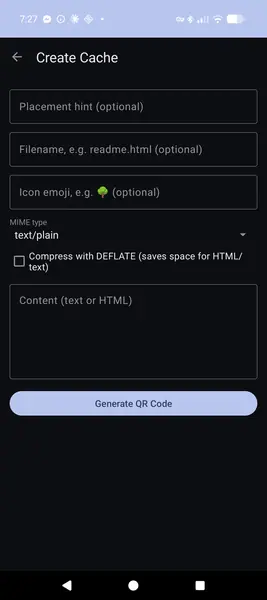
- Drop a single page — encode text, an HTML page, an SVG image, or JSON into one QR code, either in-app (Create Cache) or with the web generator.
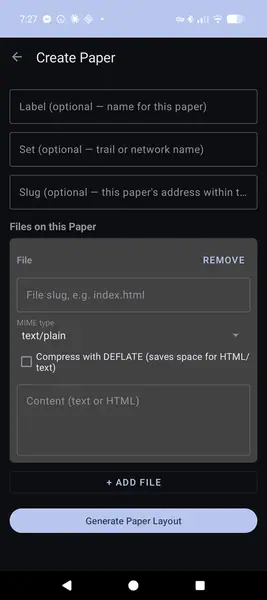
- Drop a whole "paper" — a printable sheet with a directory QR code (a paper manifest) plus one QR per file, built in-app (Create Paper) or with the web generator. Pages can link to each other with ordinary relative links, so a small static site survives being printed and scanned back in.
- Spread large content across multiple codes — split a payload too big for one QR into multiple sector codes placed along a trail. The app collects sectors in any order, reassembles and verifies them, and can recover a single missing sector from an optional parity code.
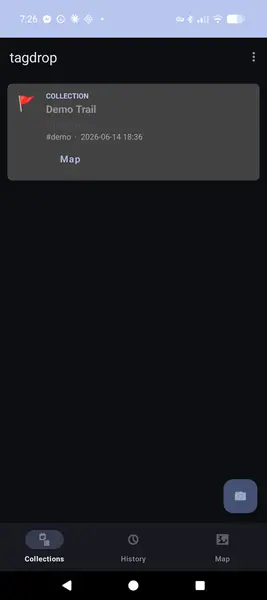
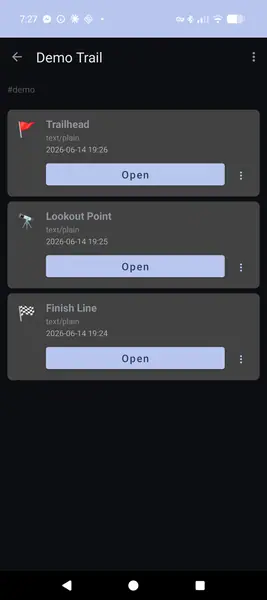
- Build trails, collections, and replies — link papers together with location hints, tag a loose set of stickers with a shared collection so they group into one card on the home screen and map, or mark a code as a reply to another to thread a conversation across drops.
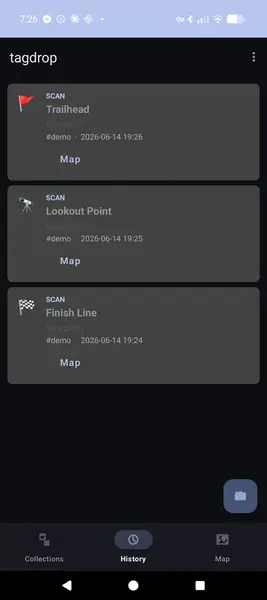
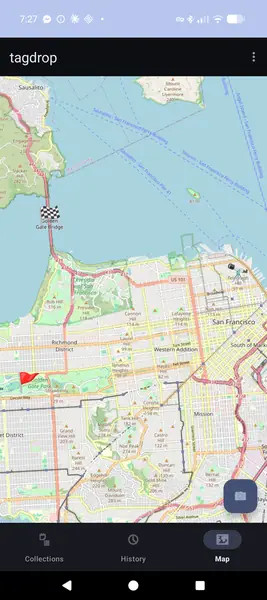
- Browse offline — scanned pages render in an in-app viewer, with search and #hashtag filtering, and a hex/CBOR inspector for the curious. The Collections, History, and Map tabs let you revisit, locate, and manage everything you've found, and a single file can back up or restore it all.
- Tap instead of scan — write any TagDrop code to a blank or rewritable NFC tag, then read it back with a tap instead of the camera.
- Sign your drops — post-quantum (ML-DSA-44) Verified Authorship signing lets anyone who scans your codes recognise them as genuinely yours after the first scan (trust-on-first-use), with a ✅/⚠️/🔏 badge shown on every signed item. Back up your signing identity to a passphrase-protected file to keep the same recognisable signer across devices.
How it works
Every code carries a tagdrop: URI — a QDEF container of CBOR Records, Base41-encoded so it packs efficiently into a QR code's alphanumeric mode. Content can optionally be DEFLATE-compressed and split across multiple codes with parity recovery. IDs are content-addressed (SHA-256 based), so identical content always gets the same ID regardless of who created it. The full wire-format spec is browsable in-app, no internet connection required.
Status
V2.5 — QDEF-based wire container encoding with content split into codes plus optional parity recovery, post-quantum (ML-DSA-44) content signing with trust-on-first-use verification, paper manifests with multi-file directories and relative-link navigation, geographic trails via "related" hints, ad-hoc collections, reply threading, an in-app scanner with a live scan board, NFC tag read/write, search and #hashtag filtering, full backup/restore, a Map tab for located finds, and remote drop-source feeds that pre-populate the map with community drops before you scan them.
Neu in Version 2.6.2
- Wire format: QDEF redefined Split's group_id as an opaque grouping token rather than a verified hash. This app adds its own payload_hash field to keep the same reassembly-integrity check (SPEC.md version 18). Multi-code QR/NFC drops (content or paper spanning more than one code) made before this update won't reassemble correctly, and vice versa — regenerate and reprint/rewrite any of those after updating. Single-code drops are unaffected.
- Security: a scanned file's declared name is now rejec
Informationen zur APK-Datei
| Paketname | com.github.mofosyne.tagdrop |
|---|---|
| Version | 2.6.2 (Code 14) |
| Mindestens | Android 6.0 · ausgelegt für Android 15 |
| Architekturen | Alle (universell) |
| SHA-256 | 014590dd5e148d511dba592cd4ba47b536adbd0356ba42cdbb67fb8981474b9d |
| Signatur | f92099033c52b7b8266928947fc0da8d0a88fd59f68e72f07f9107df316f4456 |
| Lizenz | GPL-3.0-only — freie Copyleft-Lizenz: Der Code ist öffentlich und veränderte Versionen müssen frei bleiben |
| Quellcode | github.com/mofosyne/tagdrop |
Berechtigungen
- Internetzugriff
- Kamera sensibel
- Ungefährer Standort sensibel
- Genauer Standort (GPS) sensibel
- NFC
Ältere Versionen
- tagdrop 2.6.210. August 2026 · 10,1 MB
- tagdrop 2.6.02. August 2026 · 10,1 MB
- tagdrop 2.5.129. Juli 2026 · 10,1 MB
So installieren Sie tagdrop APK
- Tippen Sie oben auf APK herunterladen und öffnen Sie die Datei nach dem Download.
- Wenn Android fragt, erlauben Sie Ihrem Browser, unbekannte Apps zu installieren.
- Tippen Sie auf Installieren. tagdrop erscheint dann bei Ihren anderen Apps.
→ APK-Datei auf Android installieren (Schritt für Schritt)
→ „App nicht installiert“: Ursachen und Lösungen
Häufige Fragen
Ist tagdrop kostenlos?
Ja. tagdrop steht unter der Lizenz GPL-3.0-only: kostenlos, ohne Abo, und der Quellcode ist öffentlich.
Ist diese APK-Datei sicher?
Die Datei wurde vom F-Droid-Repository aus dem öffentlichen Quellcode erstellt und veröffentlicht. Ihr SHA-256-Fingerabdruck steht oben, Sie können ihn nach dem Download vergleichen. Ist eine APK gefährlich? So prüfen Sie eine Datei vor der Installation
Läuft tagdrop auf meinem Handy?
Sie benötigen mindestens Android 6.0. Die App funktioniert auch ohne Google-Dienste, also auch auf aktuellen Huawei-Handys.