tagdrop APK
Decode data URIs in QR codes
Scarica l'APK v2.6.2 · 10,1 MB- Versione2.6.2
- Dimensione10,1 MB
- RichiedeAndroid 6.0
- Aggiornata10/08/2026
- LicenzaGPL-3.0-only
- PrezzoGratis
Informazioni su tagdrop
Descrizione fornita dallo sviluppatore (in inglese).
TagDrop turns small files — text, HTML pages, images, audio, SVGs — into self-contained QR codes that work completely offline. Print one on a sticker or sheet of paper and leave it somewhere; anyone with the TagDrop app (or any QR scanner that follows tagdrop: links) can scan it and view the content immediately, with no internet connection, server, or account required.
Think of it as a digital geocache: instead of a logbook in a box, the "cache" is the QR code itself.
What you can do with it
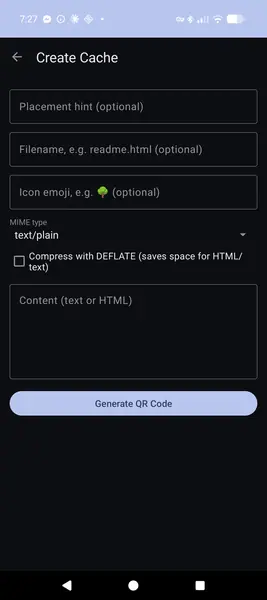
- Drop a single page — encode text, an HTML page, an SVG image, or JSON into one QR code, either in-app (Create Cache) or with the web generator.
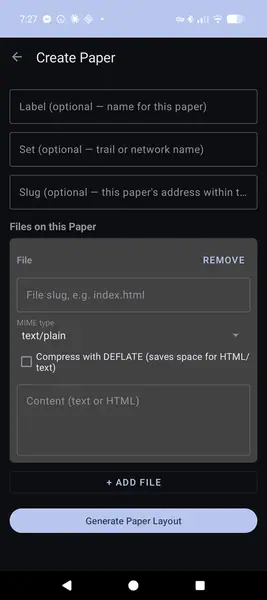
- Drop a whole "paper" — a printable sheet with a directory QR code (a paper manifest) plus one QR per file, built in-app (Create Paper) or with the web generator. Pages can link to each other with ordinary relative links, so a small static site survives being printed and scanned back in.
- Spread large content across multiple codes — split a payload too big for one QR into multiple sector codes placed along a trail. The app collects sectors in any order, reassembles and verifies them, and can recover a single missing sector from an optional parity code.
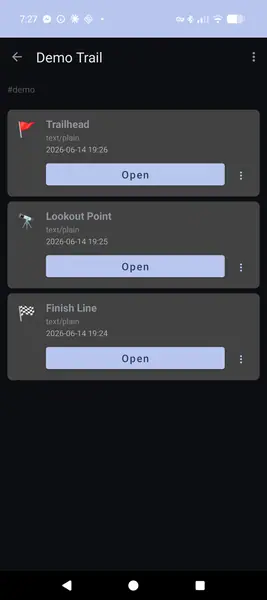
- Build trails, collections, and replies — link papers together with location hints, tag a loose set of stickers with a shared collection so they group into one card on the home screen and map, or mark a code as a reply to another to thread a conversation across drops.
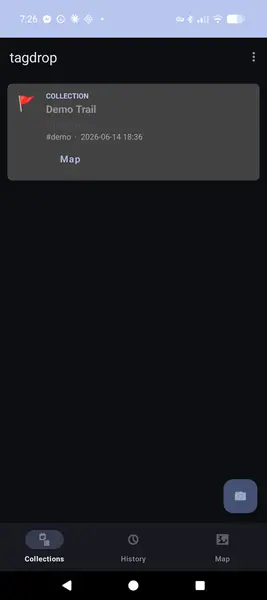
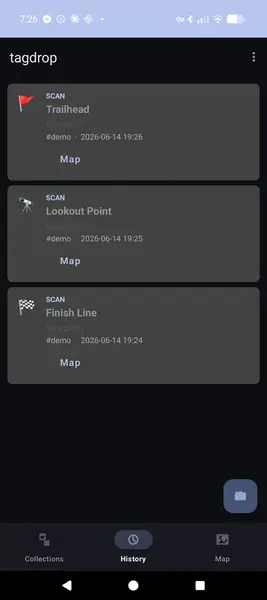
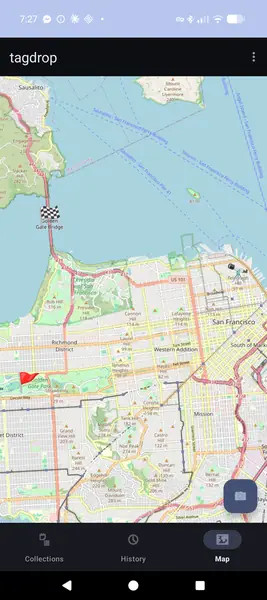
- Browse offline — scanned pages render in an in-app viewer, with search and #hashtag filtering, and a hex/CBOR inspector for the curious. The Collections, History, and Map tabs let you revisit, locate, and manage everything you've found, and a single file can back up or restore it all.
- Tap instead of scan — write any TagDrop code to a blank or rewritable NFC tag, then read it back with a tap instead of the camera.
- Sign your drops — post-quantum (ML-DSA-44) Verified Authorship signing lets anyone who scans your codes recognise them as genuinely yours after the first scan (trust-on-first-use), with a ✅/⚠️/🔏 badge shown on every signed item. Back up your signing identity to a passphrase-protected file to keep the same recognisable signer across devices.
How it works
Every code carries a tagdrop: URI — a QDEF container of CBOR Records, Base41-encoded so it packs efficiently into a QR code's alphanumeric mode. Content can optionally be DEFLATE-compressed and split across multiple codes with parity recovery. IDs are content-addressed (SHA-256 based), so identical content always gets the same ID regardless of who created it. The full wire-format spec is browsable in-app, no internet connection required.
Status
V2.5 — QDEF-based wire container encoding with content split into codes plus optional parity recovery, post-quantum (ML-DSA-44) content signing with trust-on-first-use verification, paper manifests with multi-file directories and relative-link navigation, geographic trails via "related" hints, ad-hoc collections, reply threading, an in-app scanner with a live scan board, NFC tag read/write, search and #hashtag filtering, full backup/restore, a Map tab for located finds, and remote drop-source feeds that pre-populate the map with community drops before you scan them.
Novità della versione 2.6.2
- Wire format: QDEF redefined Split's group_id as an opaque grouping token rather than a verified hash. This app adds its own payload_hash field to keep the same reassembly-integrity check (SPEC.md version 18). Multi-code QR/NFC drops (content or paper spanning more than one code) made before this update won't reassemble correctly, and vice versa — regenerate and reprint/rewrite any of those after updating. Single-code drops are unaffected.
- Security: a scanned file's declared name is now rejec
Informazioni sul file APK
| Nome del pacchetto | com.github.mofosyne.tagdrop |
|---|---|
| Versione | 2.6.2 (codice 14) |
| Android minimo | Android 6.0 · pensata per Android 15 |
| Architetture | Tutte (universale) |
| SHA-256 | 014590dd5e148d511dba592cd4ba47b536adbd0356ba42cdbb67fb8981474b9d |
| Firma | f92099033c52b7b8266928947fc0da8d0a88fd59f68e72f07f9107df316f4456 |
| Licenza | GPL-3.0-only — licenza libera copyleft: il codice è pubblico e le versioni modificate devono restare libere |
| Codice sorgente | github.com/mofosyne/tagdrop |
Autorizzazioni richieste
- Accesso a Internet
- Fotocamera sensibile
- Posizione approssimativa sensibile
- Posizione precisa (GPS) sensibile
- NFC
Versioni precedenti
- tagdrop 2.6.210 agosto 2026 · 10,1 MB
- tagdrop 2.6.02 agosto 2026 · 10,1 MB
- tagdrop 2.5.129 luglio 2026 · 10,1 MB
Come installare tagdrop APK
- Tocca Scarica l'APK qui sopra, poi apri il file al termine del download.
- Se Android lo chiede, consenti al browser di installare app sconosciute.
- Tocca Installa. tagdrop comparirà insieme alle altre app.
→ Come installare un file APK su Android (passo passo)
→ «App non installata»: cause e soluzioni
Domande frequenti
tagdrop è gratis?
Sì. tagdrop è distribuita con licenza GPL-3.0-only: gratuita, senza abbonamento e con codice sorgente pubblico.
Questo file APK è sicuro?
Il file è quello compilato e pubblicato dal repository F-Droid a partire dal codice sorgente pubblico. L'impronta SHA-256 è indicata qui sopra: puoi confrontarla dopo il download. Un APK è pericoloso? Come verificare un file prima di installarlo
tagdrop funziona sul mio telefono?
Serve almeno Android 6.0. L'app funziona anche senza i servizi Google, quindi anche sui telefoni Huawei recenti.